
Skip to product information
Bulk Order
Request a Quote

Wright Stain Powder | Romanowsky Blood Smear Stain | Ausamics
$19.00 AUD
Documentation
Wright Stain (Powder)
Hematology Stain for Blood Smears & Differential Leukocyte Counting
Catalog Number: ASD-625
Product Code: ASC-1037
CAS Number: 68988-92-1
HS Code: 3204.19.00 (Synthetic organic dyes and colouring matter)
Appearance: Dark green to black powder
Grade: Laboratory / Diagnostic Stain
Product Overview
Wright Stain is a Romanowsky-type biological stain widely used in hematology, cytology, and clinical pathology laboratories for staining peripheral blood smears and bone marrow specimens.
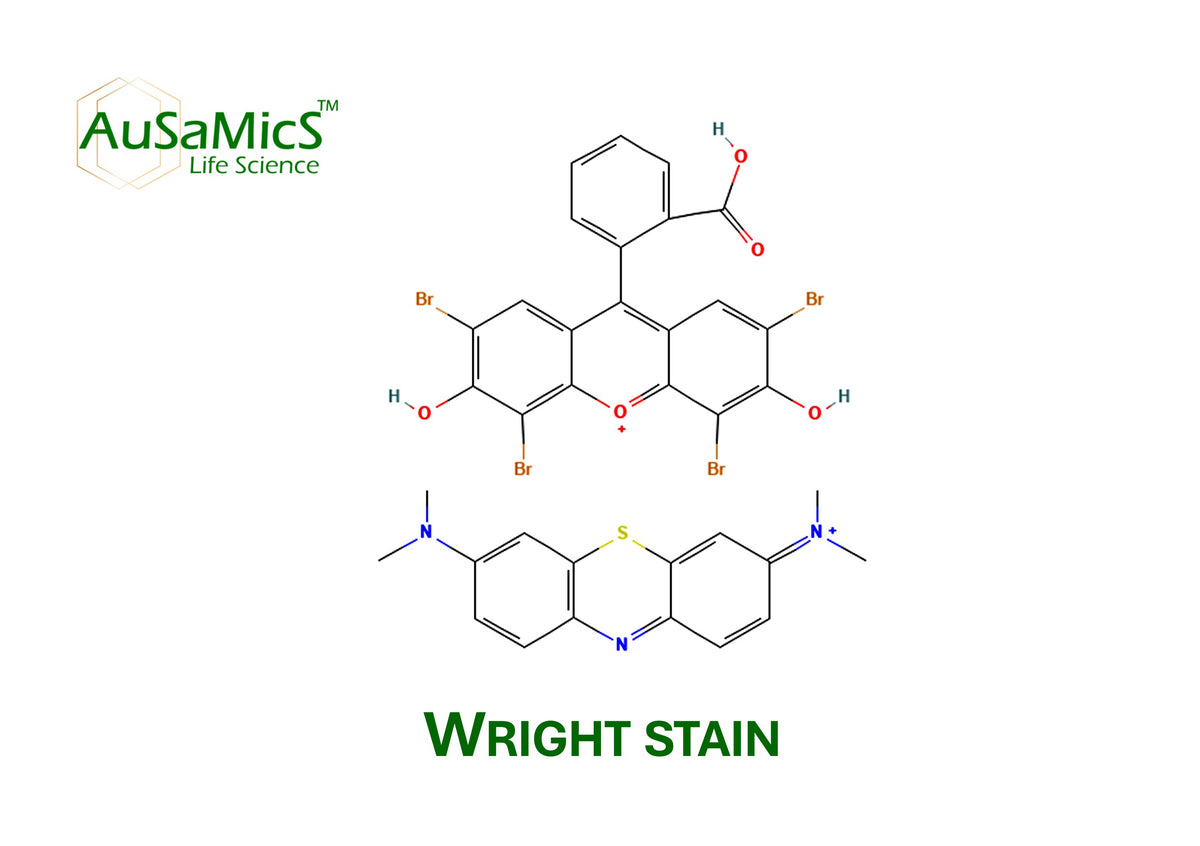
The stain is composed of a combination of eosin and methylene blue derivatives, which interact with cellular components to produce characteristic staining patterns. Wright stain enables clear visualization and differentiation of blood cell morphology, including erythrocytes, leukocytes, and platelets.
Due to its reliable staining performance and reproducible results, Wright stain is routinely used in diagnostic laboratories, hospital pathology departments, research laboratories, and teaching institutions.
Key Applications
Hematology
Wright stain is primarily used for:
-
Peripheral blood smear staining
-
Differential leukocyte counts
-
Morphological evaluation of blood cells
-
Detection of hematological abnormalities
It enables identification of:
-
Neutrophils
-
Lymphocytes
-
Monocytes
-
Eosinophils
-
Basophils
-
Platelets
Bone Marrow Cytology
Wright stain provides excellent contrast for examining:
-
Bone marrow aspirates
-
Immature blood cells
-
Leukemia and hematologic disorders
Parasitology
Wright stain can assist in the microscopic identification of blood parasites, including:
-
Plasmodium species (malaria studies)
-
Trypanosomes
-
Other intracellular parasites in blood smears
Staining Principle
Wright stain belongs to the Romanowsky stain family.
It contains:
-
Basic dyes (methylene blue derivatives) that stain acidic cellular components such as nuclei and RNA.
-
Acidic dye (eosin) that stains basic components such as cytoplasm and hemoglobin.
This differential interaction produces characteristic colors:
| Cellular Component | Colour |
|---|---|
| Nuclei | Purple / dark blue |
| Cytoplasm | Light blue |
| Erythrocytes | Pink to orange |
| Eosinophil granules | Bright red |
| Basophil granules | Deep purple |
Product Features
-
High-quality Romanowsky-type stain
-
Reliable differentiation of blood cell morphology
-
Excellent contrast for microscopic examination
-
Suitable for hematology and cytology laboratories
-
Consistent staining performance
-
Fine powder for easy solution preparation
Specifications
| Property | Value |
|---|---|
| Product Name | Wright Stain |
| Catalog Number | ASD-625 |
| Product Code | ASC-1037 |
| CAS Number | 68988-92-1 |
| HS Code | 3204.19.00 |
| Appearance | Dark green to black powder |
| Solubility | Soluble in methanol |
| Grade | Laboratory / Diagnostic stain |
Typical Preparation
A commonly used Wright staining solution may be prepared by dissolving the dye in methanol or methanol-buffer mixtures, depending on laboratory protocols.
Prepared staining solutions should be filtered before use to ensure uniform staining.
Storage
Store tightly sealed in a cool, dry environment protected from light and moisture.
Recommended storage temperature:
15–25°C
Safety Information
Use appropriate laboratory protective equipment when handling staining reagents.
Recommended PPE:
-
Laboratory coat
-
Protective gloves
-
Safety goggles
For laboratory and research use only.
Not intended for human or veterinary therapeutic use.
Packaging & Availability
Available in multiple packaging sizes suitable for laboratory and research use:
-
10 g
-
25 g
-
100 g
-
500 g
-
Bulk quantities available upon request