Overview
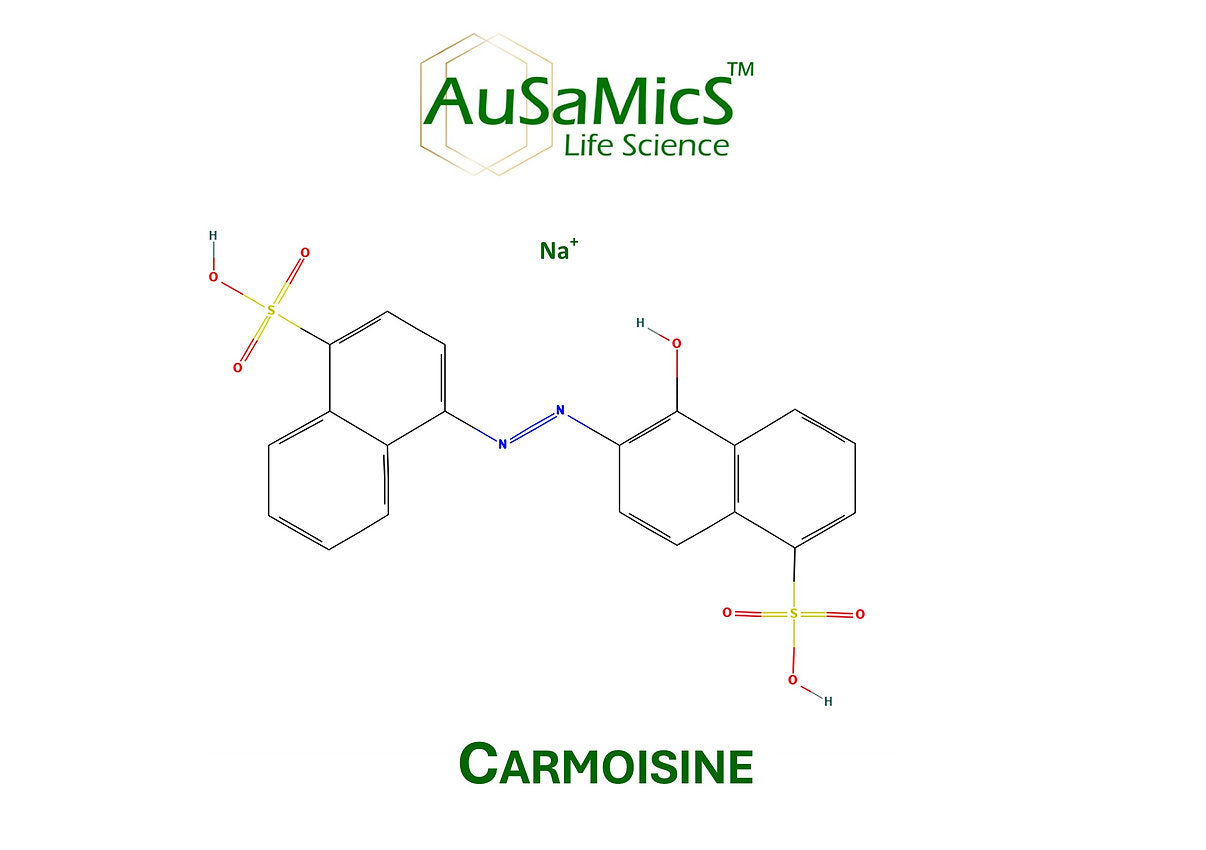
Carmoisine (Azorubine, E122, Acid Red 14) is a food-grade synthetic monoazo colourant widely used in regulated food, beverage, pharmaceutical, cosmetic, and laboratory applications. Supplied as a dark red to maroon powder, it produces a clear, bright red solution in water with high colour strength and excellent stability under typical processing conditions.
Product Identification
| Parameter |
Detail |
| Catalogue Number |
ASD-637 |
| CAS Number |
3567-69-9 |
| C.I. Name |
Acid Red 14 |
| Colour Index Number |
CI 14720 |
| E Number |
E122 |
| EINECS Number |
222-657-4 |
| Dye Class |
Monoazo dye |
| Synonyms |
Azorubine, Food Red 3, Chromotrope FB, Azorubin S, Brillantcarmoisin O |
| HS / AHECC Code |
3204.19.00 — Synthetic organic colouring matter |
Key Features & Benefits
Colour Performance
- Intense red shade with high chromatic strength
- Freely soluble in water — clear, bright red solutions
- Good stability under heat, light, and pH variations
Quality & Documentation
- Food-grade purity with defined specifications
- Consistent batch-to-batch performance
- Full COA, TDS, and SDS documentation
Supply Advantage
- Manufactured and packed locally in Melbourne
- Fast local dispatch — no import lead times
- Technical support from AuSaMicS Life Science
Regulatory
- Permitted under FSANZ and Codex Alimentarius
- Approved as E122 under EU food additive regulations
- Compliance documentation available on request
Typical Applications
| Sector |
Application |
| Food & Beverage |
Beverages, confectionery, bakery products, dairy formulations, sauces, processed foods — in accordance with FSANZ and Codex MPLs |
| Pharmaceutical |
Colouring of capsule shells, syrups, oral liquids, and topical formulations |
| Cosmetics |
Creams, personal care products, and colour cosmetics where E122 is permitted |
| Laboratory |
Culture media colourant, visual tracers, formulation studies, QC reference standards |
Chemical & Functional Principle
Carmoisine is an anionic monoazo dye containing sulfonate functional groups (–SO₃Na) that confer high water solubility and uniform dispersion in aqueous systems. Its conjugated azo chromophore (–N=N–) absorbs visible light at approximately 516 nm, producing the characteristic bright red colour. The sulfonate groups also provide stability against pH variation and moderate heat, making it suitable for a wide range of food and industrial processing conditions.
Physical Properties
| Property |
Value |
| Appearance |
Dark red to maroon powder |
| Solubility |
Freely soluble in water |
| Solution colour |
Bright red |
| Odour |
Odourless |
| Absorption max (λmax) |
~516 nm (aqueous solution) |
| Molecular formula |
C₂₀H₁₂N₂Na₂O₇S₂ |
| Molecular weight |
502.43 g/mol |
Storage & Shelf Life
- Store in a cool, dry place away from direct light
- Keep container tightly sealed when not in use
- Protect from moisture and contamination
- Shelf life: up to 3 years under recommended storage conditions
Regulatory & Compliance Summary
| Jurisdiction |
Status |
| Australia / New Zealand (FSANZ) |
Permitted food colourant — subject to maximum permitted levels (MPL) |
| European Union |
Approved as E122 under EU food additive regulations |
| Codex Alimentarius |
Listed — subject to MPL per food category |
| United States (FDA) |
Not approved for food use in the USA |
⚠️ Regulatory Note: Final product suitability, use levels, and regulatory compliance must be determined by the end user in accordance with FSANZ, Codex Alimentarius, and other applicable national regulations. Carmoisine is not approved for food use in the United States. Not intended for therapeutic or medicinal use.
Technical Overview & Biochemistry
Carmoisine belongs to the monoazo class of synthetic dyes and is produced by coupling diazotised naphthionic acid with 2-naphthol-6,8-disulfonic acid (Schaeffer's Salt) under alkaline conditions. The resulting disodium salt is the commercially supplied form. Its anionic character means it binds strongly to cationic substrates and proteins, which underlies its use in certain analytical and microbiological staining applications in addition to food colouring. Lightfastness is moderate — protect final products from prolonged UV exposure.
Cross-Reference / Equivalent Products
| Brand |
Product Name |
Catalogue Number |
| Sigma-Aldrich (Merck) |
Carmoisine, food grade |
— |
| Spectrum Chemical |
Carmoisine (Azorubine) FCC |
— |
| TCI Chemicals |
Acid Red 14 |
A5160 |
| Avantor (VWR) |
Carmoisine E122 |
— |
Intent-Based Long-Tail Search Queries
- buy Carmoisine E122 Australia food grade
- Azorubine CAS 3567-69-9 supplier Melbourne
- Food Red 3 E122 powder 1kg Australia
- Acid Red 14 CI 14720 laboratory grade supply
- Carmoisine food colourant COA SDS Australia
- E122 azo dye local supplier fast dispatch
Download Product Description (PDF)
Technical Data Sheet — ASD-637
The Technical Data Sheet for Carmoisine (ASD-637) covers physicochemical specifications, quality parameters, mode of action, and peer-reviewed literature references in accordance with AuSaMicS TDS Option 2 documentation standards.
Typical Quality Parameters
| Parameter |
Specification |
Method |
| Total Dye Content |
≥ 86–87% |
Spectrophotometric |
| Loss on Drying (135°C) |
≤ 13% |
Gravimetric |
| Water Insoluble Matter |
≤ 0.09% |
Gravimetric filtration |
| Ether Extracts |
≤ 0.2% |
Solvent extraction |
| Subsidiary Dyes |
≤ 0.17% |
TLC / HPLC |
| Dye Intermediates |
≤ 0.16% |
HPLC |
| Unsulfonated Aromatic Amines |
≤ 0.01% |
GC / HPLC |
| Heavy Metals (as Pb) |
≤ 40 ppm |
ICP-OES |
| Lead (Pb) |
≤ 1.3 ppm |
ICP-OES |
| Arsenic (As) |
≤ 1 ppm |
ICP-OES |
Physicochemical Properties
| Property |
Value |
| Appearance |
Dark red to maroon powder |
| Molecular formula |
C₂₀H₁₂N₂Na₂O₇S₂ |
| Molecular weight |
502.43 g/mol |
| Absorption maximum (λmax) |
~516 nm (aqueous solution) |
| Solubility |
Freely soluble in water; very slightly soluble in ethanol |
| pH stability range |
Stable from approximately pH 3–9 |
| Melting point |
> 300°C (decomposes) |
| Storage temperature |
Ambient (15–25°C), dry, away from light |
| Shelf life |
Up to 3 years under recommended conditions |
Mode of Action
Carmoisine is an anionic monoazo dye. Its chromophoric system — based on the azo linkage (–N=N–) conjugated with the naphthalene ring systems — absorbs visible radiation at ~516 nm, producing bright red coloration in solution. The disodium sulfonate groups (–SO₃Na) provide high aqueous solubility and anionic character, enabling electrostatic interaction with cationic surfaces and proteins. In food applications, Carmoisine distributes uniformly in aqueous matrices. In laboratory applications, its affinity for protein-rich substrates supports its use as a biological stain.
Literature References
- European Food Safety Authority (EFSA). (2009). Scientific Opinion on the re-evaluation of Carmoisine (E 122) as a food additive. EFSA Journal, 7(11), 1332.
- Food Standards Australia New Zealand (FSANZ). Food Additives — Carmoisine (E122). FSANZ Food Standards Code, Standard 1.3.1.
- Griffiths, J. (1984). Colour and constitution of organic molecules. In Developments in the Chemistry and Technology of Organic Dyes. Blackwell Scientific, Oxford.
- Gupta, S.S., et al. (2012). Analytical methods for determination of synthetic food colours. Food Chemistry, 132(3), 1143–1150.
Full TDS document (five-file AuSaMicS documentation set: PD, TDS, SDS, COA + HTML embed) available as downloadable PDF.
Download TDS (PDF)
Safety Data Sheet — Summary (ASD-637)
Full 16-section SDS prepared in accordance with the GHS (7th Revised Edition) and Australian WHS Regulations (Safe Work Australia).
| Section |
Summary |
| 1. Identification |
Carmoisine (Azorubine, E122, Acid Red 14), ASD-637. AuSaMicS Pty Ltd, 31 Longview CT, Thomastown VIC 3074. support@ausamics.com | +61 412 520 598. Emergency: Poisons Information Centre 13 11 26. |
| 2. Hazard Identification |
Not classified as hazardous under Australian WHS Regulations / GHS. No signal word or hazard pictograms required. Standard laboratory precautions apply. |
| 3. Composition |
Disodium (4E)-3-oxo-4-[(4-sulfonato-1-naphthyl)hydrazinylidene]naphthalene-2,7-disulfonate. CAS 3567-69-9. No hazardous ingredients above threshold. |
| 4. First Aid |
Inhalation: fresh air. Skin/eye: wash with water 15 min. Ingestion: rinse mouth, seek medical advice if symptomatic. No specific antidote. |
| 5. Fire Fighting |
Not flammable. Use extinguishing agents appropriate to surroundings. Combustion may yield CO₂, CO, NOx, SOx. |
| 6. Accidental Release |
Avoid dust generation. Sweep or vacuum powder; collect in sealed labelled container. Avoid release to waterways — causes visible staining. |
| 7. Handling & Storage |
Handle in well-ventilated area. Avoid dust inhalation. Store at 15–25°C, dry, sealed, away from light. Keep from oxidising agents. |
| 8. Exposure Controls / PPE |
Nitrile gloves, safety spectacles, lab coat. Dust mask if handling large quantities. Local exhaust ventilation recommended. No specific OEL established. |
| 9. Physical & Chemical Properties |
Dark red powder. Odourless. Freely water-soluble. λmax ~516 nm. MW 502.43 g/mol. Decomposes >300°C. Not flammable, not explosive, not oxidising. |
| 10. Stability & Reactivity |
Stable under recommended storage. Avoid strong oxidising agents, strong reducing agents, prolonged UV. No hazardous polymerisation. |
| 11. Toxicological Info |
No significant acute or chronic toxicity at normal use levels. May cause sensitisation in susceptible individuals. No evidence of carcinogenicity at food-use levels per EFSA 2009 review. |
| 12. Ecological Info |
Azo dyes may persist in aquatic environments and cause visible discolouration. Avoid large-scale release to waterways. Biodegradability varies. |
| 13. Disposal |
Dispose as non-hazardous waste per local EPA / council regulations. Do not discharge concentrated solutions to drains — causes persistent staining. Dilute and treat if large quantities. |
| 14. Transport |
Not classified as dangerous goods: ADG, IATA, IMDG. No UN Number, no packing group. Protect from moisture during transport. |
| 15. Regulatory |
Compliant with Australian WHS Regulations and GHS Rev. 7. HS Code: 3204.19.00. Permitted food additive E122 in Australia (FSANZ) and EU. Not approved for food use in the USA. |
| 16. Other Information |
SDS Ref: SDS-ASD-637-CARM. Issue Date: January 2026. Prepared by Hassan Salimi, AuSaMicS Pty Ltd. Review: January 2028 or upon formulation change. |
Full 16-section GHS-compliant SDS available as downloadable PDF.
Download SDS (PDF)
Certificate of Analysis — ASD-637
Each batch of Carmoisine (ASD-637) is released with a batch-specific Certificate of Analysis confirming compliance with AuSaMicS quality specifications.
Typical COA Results
| Test Parameter |
Specification |
Method |
Typical Result |
| Total Dye Content |
≥ 86–87% |
Spectrophotometric |
Conforms |
| Loss on Drying (135°C) |
≤ 13% |
Gravimetric |
Conforms |
| Water Insoluble Matter |
≤ 0.09% |
Filtration |
Conforms |
| Ether Extracts |
≤ 0.2% |
Solvent extraction |
Conforms |
| Subsidiary Dyes |
≤ 0.17% |
HPLC |
Conforms |
| Dye Intermediates |
≤ 0.16% |
HPLC |
Conforms |
| Unsulfonated Aromatic Amines |
≤ 0.01% |
GC/HPLC |
Conforms |
| Heavy Metals (as Pb) |
≤ 40 ppm |
ICP-OES |
Conforms |
| Lead (Pb) |
≤ 1.3 ppm |
ICP-OES |
Conforms |
| Arsenic (As) |
≤ 1 ppm |
ICP-OES |
Conforms |
| Appearance |
Dark red to maroon powder |
Visual |
Conforms |
| Solubility |
Freely soluble in water |
Visual |
Conforms |
Batch Traceability
| Field |
Detail |
| Product |
Carmoisine (Azorubine, E122, Food Red 3) |
| Catalogue Number |
ASD-637 |
| Manufacturer |
AuSaMicS Pty Ltd, 31 Longview CT, Thomastown VIC 3074 |
| Batch Number |
Stated on label |
| Manufacturing Date |
Stated on label |
| Expiry Date |
Stated on label (up to 3 years from manufacture) |
| Storage |
15–25°C, dry, sealed, away from light |
| Intended Use |
Food, pharmaceutical, cosmetic, laboratory — where permitted |
Batch-specific COA issued at time of dispatch. Available as downloadable PDF or on request.
Download COA (PDF) Request Batch COA