
Skip to product information
Bulk Order
Request a Quote
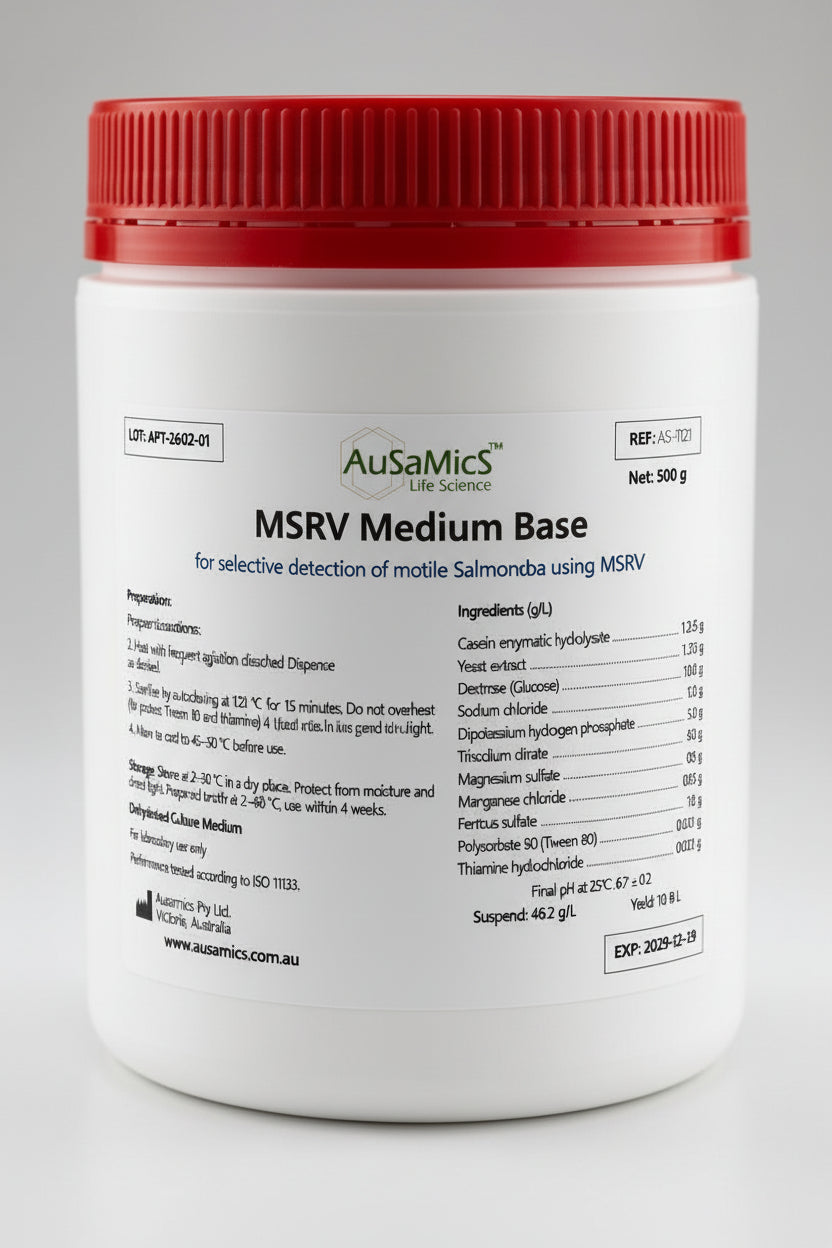
MSRV Medium Base | Modified Semi‑solid Rappaport‑Vassiliadis | AS‑1298
$35.00 AUD
AuSaMicS Life Science • Selective Enrichment Media
MSRV Medium Base
Modified Semi-solid Rappaport-Vassiliadis Medium
The ISO 6579-1:2017 (Annex D) reference medium for selective detection of motile Salmonella spp. in food, feed, and environmental samples. MSRV exploits Salmonella's unique motility — visible migration halos through semi-solid agar provide clear, unambiguous positive results with outstanding sensitivity and specificity.
Cat #: AS-1298
ISO 6579-1:2017 Annex D
✓ Australian Stock
🔵 Motility Halo Detection
🚀 Same-Day Dispatch: Australian Stock
🦠 Salmonella Detection: ISO 6579-1 Annex D Method
🌡️ 41.5°C Incubation: 24–48 h semi-solid migration
🏆 Salmonella Detection Specialist
🔵 Motility Halos — Visible migration, unambiguous result
🧫 ISO 6579-1 Reference — Annex D method
📋 Complete Package — COA + SDS included
⚡ Fast Supply — Ships within 24h
📞 Expert Support — Protocol optimization
⚠️ Supplement Required
Use with MSRV Selective Supplement (novobiocin) per ISO 6579-1
🔬 Technical Overview & Biochemistry
MSRV is a modified semi-solid selective enrichment medium specifically designed to detect motile Salmonella spp. in food, feed, and environmental matrices. Originally derived from the Rappaport-Vassiliadis formulation, the MSRV format replaces the liquid broth with a semi-solid agar matrix (0.16–0.18% agar) — a critical innovation that exploits Salmonella's flagella-driven motility as a primary selection criterion, physically separating motile Salmonella from non-motile background flora.
Selectivity & Motility-Based Detection Strategy:
Semi-solid Agar Matrix (0.16–0.18%) — Viscosity calibrated to permit flagellated motile organisms to swim freely while immobilising non-motile organisms at the inoculation point
Malachite Green — Bacteriostatic dye; inhibits gram-positive organisms and suppresses the majority of non-enteric gram-negative background flora
Magnesium Chloride / Low pH — Physiological stress conditions that favour Salmonella survival and suppress competing Enterobacteriaceae (especially E. coli)
Novobiocin (MSRV Supplement) — Broad-spectrum antibiotic added via selective supplement; inhibits competing gram-negative organisms including coliforms while Salmonella is relatively resistant
Peptone / Soy Peptone — Nutritive base supporting growth and motility expression under selective conditions
Semi-solid Agar Matrix (0.16–0.18%) — Viscosity calibrated to permit flagellated motile organisms to swim freely while immobilising non-motile organisms at the inoculation point
Malachite Green — Bacteriostatic dye; inhibits gram-positive organisms and suppresses the majority of non-enteric gram-negative background flora
Magnesium Chloride / Low pH — Physiological stress conditions that favour Salmonella survival and suppress competing Enterobacteriaceae (especially E. coli)
Novobiocin (MSRV Supplement) — Broad-spectrum antibiotic added via selective supplement; inhibits competing gram-negative organisms including coliforms while Salmonella is relatively resistant
Peptone / Soy Peptone — Nutritive base supporting growth and motility expression under selective conditions
Result Interpretation: A diffuse turbid halo migrating outward from the inoculation point = presumptive positive for motile Salmonella. No migration (growth confined to inoculation point only) = negative. Positive results must be confirmed by subculture to selective agar (e.g., XLD, BGA) followed by biochemical and serological confirmation.
⚙️ Mode of Action
Salmonella spp. are peritrichously flagellated, highly motile organisms. When inoculated onto the surface of MSRV, motile Salmonella cells actively swim through the semi-solid agar matrix, migrating radially outward from the point of inoculation and producing a visible, opaque, diffuse halo over 24–48 h at 41.5°C. Non-motile organisms — including the majority of competing background flora — cannot migrate and remain confined to the inoculation point. Malachite green and novobiocin simultaneously suppress non-Salmonella flora, while the low pH (5.2) and elevated magnesium chloride concentration impose selective physiological stress. The elevated incubation temperature (41.5°C) further enriches for thermotolerant Salmonella serovars over mesophilic competitors — delivering exceptional specificity for this important foodborne pathogen.
📊 Salmonella Enrichment & Isolation Media Comparison
🧬 Applications
🍗 Food Safety Testing
Detection of Salmonella spp. in all food categories — poultry, meat, dairy, eggs, produce, herbs and spices, infant formula, pet food, and processed foods per ISO 6579-1:2017 and AS 5013.10.
🌾 Animal Feed & Pet Food
Mandatory Salmonella absence testing in animal feed, fishmeal, bone meal, and pet food — high-load matrices where MSRV's motility-based selectivity provides a significant sensitivity advantage.
🏭 Environmental Monitoring
Swab and rinse testing of food production environments, abattoir surfaces, processing equipment, drains, and factory floors — critical for HACCP verification and site hygiene validation.
💊 Pharmaceutical QC
Absence of Salmonella testing in non-sterile pharmaceutical products, herbal medicines, dietary supplements, and raw material ingredients per TGA, BP, and USP requirements.
Additional Laboratory Applications:
- Dried Foods & Spices: High-risk import/export verification testing
- Infant Formula: Regulatory absence testing per Codex Alimentarius
- Water Testing: Surface water and irrigation water surveillance
- NATA Accredited Labs: ISO 17025 food and environmental panels
- Export Certification: AQIS and DAFF export compliance testing
- Research: Salmonella ecology, virulence, and AMR studies
🇦🇺 Salmonellosis in Australia — Why MSRV Matters
Salmonella is the second most notified foodborne pathogen in Australia after Campylobacter, with OzFoodNet and NNDSS recording thousands of confirmed cases annually. Non-typhoidal Salmonella causes significant morbidity and is a leading cause of food recall events in Australia. MSRV is the ISO 6579-1:2017 (Annex D) mandated selective enrichment medium — the current international gold standard for horizontal detection across all food categories.
📊 #2 notified foodborne pathogen in Australia
🍗 Poultry, eggs & produce leading vehicles
🔬 ISO 6579-1:2017 Annex D — current gold standard
📋 ISO 6579-1:2017 Detection Workflow
STEP 1 — 18 h / 37°C
🧪
Pre-enrichment (BPW)
Homogenise 25 g sample in 225 mL Buffered Peptone Water. Incubate 37 ± 1°C for 18 h.
STEP 2 — MSRV Inoculation
💧
Inoculate MSRV
Pipette 0.1 mL BPW enrichment onto surface of MSRV plate (do not spread). Use two plates per sample.
STEP 3 — 24–48 h / 41.5°C
🌡️
Incubate MSRV
Incubate 41.5 ± 0.5°C for 24 h. Read at 24 h; if negative, re-incubate and read again at 48 h.
STEP 4 — Reading
🔵
Read Migration Halo
Diffuse turbid halo extending from inoculation point = presumptive positive. Confined growth = negative.
STEP 5 — Confirmation
🔬
Subculture & Confirm
Streak from halo margin onto XLD + BGA. Incubate 37°C / 24 h. Confirm by biochemical ID and serology.
📖 MSRV Halo Reading Guide
✅ Positive Result:
Diffuse, opaque, whitish-grey halo migrating radially outward from the inoculation point. Halo typically >5 mm diameter at 24 h. Best observed on a dark background using transmitted light.
Diffuse, opaque, whitish-grey halo migrating radially outward from the inoculation point. Halo typically >5 mm diameter at 24 h. Best observed on a dark background using transmitted light.
❌ Negative Result:
Growth confined strictly to the inoculation point with no outward migration. Plate may show a small, well-defined zone of growth only at the inoculation site.
Growth confined strictly to the inoculation point with no outward migration. Plate may show a small, well-defined zone of growth only at the inoculation site.
⚠️ Equivocal / Retest:
Faint or poorly defined halo — re-incubate to 48 h or subculture from inoculation point to selective agar regardless. Do not discard presumptive negatives before 48 h.
Faint or poorly defined halo — re-incubate to 48 h or subculture from inoculation point to selective agar regardless. Do not discard presumptive negatives before 48 h.
⚠️ Critical: Pipette the 0.1 mL BPW drop gently onto the MSRV surface — do not spread. Spreading disrupts the motility gradient and invalidates the halo reading. Always inoculate duplicate MSRV plates per sample per ISO 6579-1 Annex D.
💡 Protocol Optimization Guidelines
Preparation:
Dissolve 26.6 g/L in purified water. Heat gently to dissolve. Autoclave 115°C / 15 min (not 121°C — lower temp preserves semi-solid consistency). Cool to 47–50°C before adding supplement.
Dissolve 26.6 g/L in purified water. Heat gently to dissolve. Autoclave 115°C / 15 min (not 121°C — lower temp preserves semi-solid consistency). Cool to 47–50°C before adding supplement.
pH (25°C):
5.2 ± 0.2 after sterilisation. The low pH is a key selective feature — verify with calibrated pH meter.
5.2 ± 0.2 after sterilisation. The low pH is a key selective feature — verify with calibrated pH meter.
Agar Concentration:
Critical — must be 0.16–0.18% for correct semi-solid consistency. Too firm prevents migration; too soft gives non-specific spreading.
Critical — must be 0.16–0.18% for correct semi-solid consistency. Too firm prevents migration; too soft gives non-specific spreading.
Storage (prepared plates):
2–8°C, use within 2 weeks. Plates must be dry-surfaced before use — pre-dry 15–30 min in incubator at 37°C. Dehydrated powder: below 25°C, dry and dark.
2–8°C, use within 2 weeks. Plates must be dry-surfaced before use — pre-dry 15–30 min in incubator at 37°C. Dehydrated powder: below 25°C, dry and dark.
📋 Technical Specifications
| Catalogue Number | AS-1298 |
| Full Name | Modified Semi-solid Rappaport-Vassiliadis Medium Base |
| Format | Dehydrated powder (base only) |
| Reconstitution | 26.6 g/L in purified water |
| pH (25°C) | 5.2 ± 0.2 (selective low pH) |
| Agar Concentration | 0.16–0.18% (semi-solid) |
| Incubation Temp | 41.5 ± 0.5°C |
| Incubation Time | 24–48 hours |
| Positive Result | Diffuse turbid migration halo |
| Negative Result | Growth confined to inoculation point |
| Supplement Required | Yes — MSRV Selective Supplement (novobiocin) |
| Sterilisation | Autoclave 115°C / 15 min |
| HS Code | 3821.00.00 |
✅ Quality Control Performance
| Test Organism | ATCC | Expected Result | CFU Spec |
|---|---|---|---|
| Salmonella Typhimurium | 14028 | Migration halo, good growth | ≤100 CFU |
| Salmonella Enteritidis | 13076 | Migration halo, good growth | ≤100 CFU |
| Escherichia coli | 25922 | Inhibited / no migration | ≤100 CFU |
| Enterococcus faecalis | 19433 | Inhibited / no migration | ≤100 CFU |
🧪 Typical Base Formulation (per litre)
| Soya Peptone | 4.54 g |
| Magnesium Chloride (anhydrous) | 10.93 g |
| Sodium Chloride | 7.34 g |
| Dipotassium Hydrogen Phosphate | 1.45 g |
| Potassium Dihydrogen Phosphate | 0.74 g |
| Malachite Green Oxalate | 0.036 g |
| Agar (semi-solid grade) | 1.8 g |
| + MSRV Selective Supplement | 1 vial / L |
MSRV Selective Supplement contains: Novobiocin (10 mg/L completed medium). Sold separately.
* Formulation may vary slightly between lot numbers. Refer to the current COA for exact composition.
📜 Standards & Regulatory Compliance
- ✓ ISO 6579-1:2017 Annex D — Horizontal method: detection of Salmonella spp.
- ✓ EN ISO 6579 — European equivalent standard for food and feed
- ✓ AS 5013.10 — Australian Standard for Salmonella in food
- ✓ FSANZ Food Standards — Australian / NZ regulatory compliance
- ✓ FDA BAM Chapter 5 — Salmonella species in foods (US reference)
- ✓ Codex Alimentarius — International food safety standard compliance
- ✓ NATA Accreditation — Suitable for ISO 17025-accredited food labs
📝 Alternative Names
MSRV Medium Base
Modified Semi-solid Rappaport-Vassiliadis Medium
MSRV Base / MRSV Base
Semi-solid RV Medium
Rappaport-Vassiliadis Semi-solid Medium
Motility Salmonella Selective Agar
🔄 Cross-Reference / Equivalent Products
Cross-references are provided for convenience. Catalogue numbers are trademarks of their respective owners. AuSaMicS products are manufactured and quality-tested independently.
🧬 Complete Salmonella Detection System
Pre-enrichment & Selective Enrichment Media
Selective Isolation & Confirmation Agar
Need Salmonella Detection Method Support?
Our food safety microbiologists can assist with ISO 6579-1:2017 Annex D full workflow setup, MSRV halo reading training, FSANZ and NATA compliance documentation, and method validation for accredited laboratories.
For laboratory, research, and industrial use only. Not for food, feed, household, cosmetic, therapeutic, or personal use. Results must be confirmed by subculture to selective agar followed by biochemical and serological identification before reporting as Salmonella-positive. Results should be interpreted by qualified laboratory personnel in accordance with ISO 6579-1:2017.
AuSaMicS Pty Ltd | ABN: 56 676 640 467 | 31 Longview CT, Thomastown VIC 3074, Australia
www.ausamics.com.au | support@ausamics.com.au | +61 412 520 598
Same-day dispatch • Australian stock • Full documentation included