
Skip to product information
Request a Quote


Tryptic Soy Agar (TSA / CASO Agar) | General Growth Medium for Bacteria AS-1370
$29.00 AUD
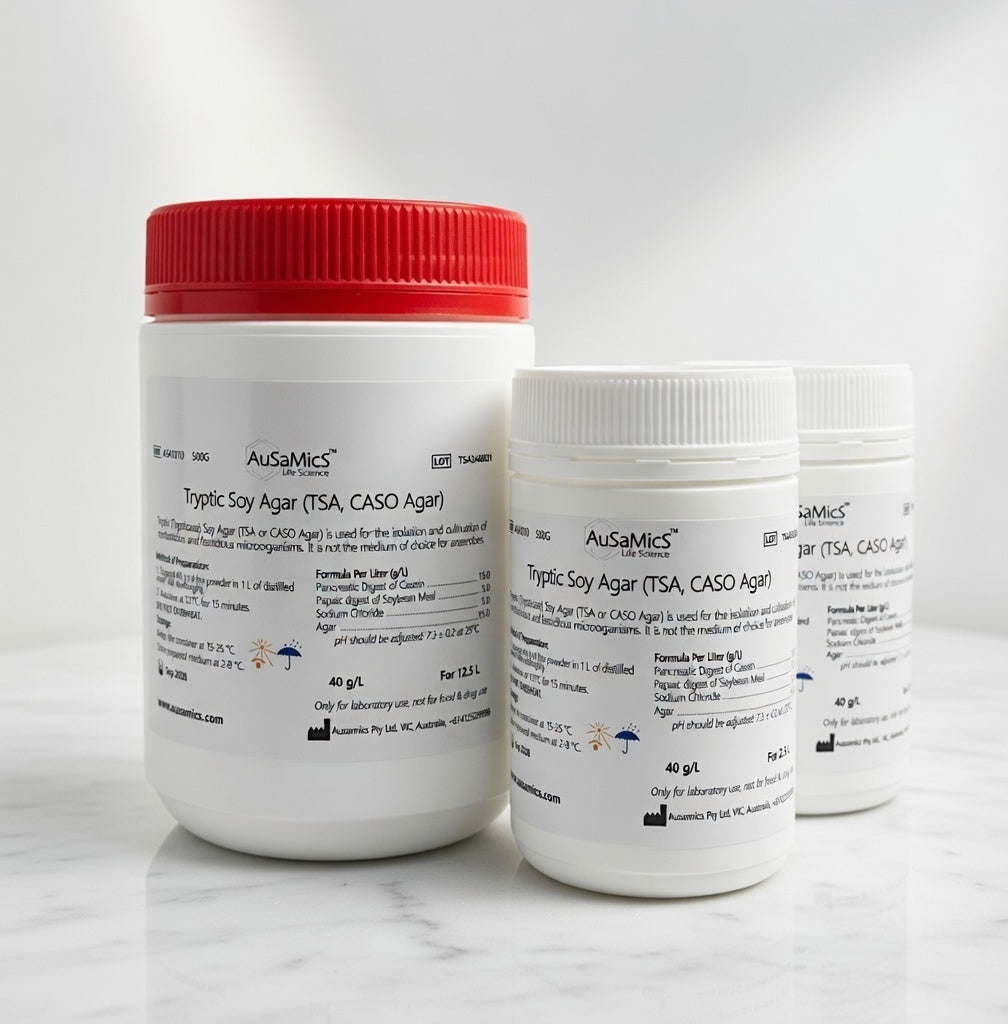
Tryptic Soy Agar (TSA / CASO Agar)
General-Purpose Culture Medium for Microbiological Research, Quality Control & Pharmacopoeial Testing | Cat. No. AS-1370
Cat. No. AS-1370 pH 7.3 ± 0.2 40 g/L 500 g → 12.5 L Batch TSA240021 | EXP Sep. 2028 ✓ USP / EP / JP Compliant ✓ BD Difco 236950 Equivalent 🇦🇺 Made in Melbourne ⚡ Same-Week Dispatch
Cat. No.
AS-1370
pH (25°C)
7.3 ± 0.2
Dissolution
40 g/L
Batch
TSA240021
Expiry
Sep. 2028
📄 Full DocumentationCOA, TDS & SDS every batch
🇦🇺 Australian StockNo import delays
⚡ Same-Week DispatchMelbourne warehouse
🔬 Technical SupportDirect from our team
Current Batch Information
Catalogue No.AS-1370
Batch No.TSA240021
Pack Size500 g
Makes12.5 L prepared medium
Dissolution40 g/L
pH (25°C)7.3 ± 0.2
ExpirySeptember 2028
Autoclave121°C / 15 min
Overview
Tryptic Soy Agar (TSA), also known as CASO Agar (Casein Soya Bean Digest Agar) or SCDA (Soybean-Casein Digest Agar), is the most widely used general-purpose solid culture medium in microbiological laboratories worldwide. It supports the growth of a broad spectrum of organisms — fastidious and non-fastidious bacteria, yeasts, and moulds — by providing a nutritionally complete, balanced environment at neutral pH.
Its dual-peptone formulation — Pancreatic Digest of Casein (Tryptone) combined with Papaic Digest of Soybean Meal (Soytone) — delivers complementary nutritional profiles that cover the growth requirements of virtually all non-obligate anaerobes. TSA is the standard baseline medium for routine cultivation, enumeration, sterility testing (USP/EP/JP), environmental monitoring, and strain maintenance.
Mode of Action — Why the Dual Peptone System Works
Pancreatic Digest of Casein (Tryptone, 15.0 g/L): Produced by tryptic hydrolysis of casein. Rich in tryptophan, branched-chain amino acids, and short peptides providing rapid nitrogen availability. The primary nitrogen and carbon source for most organisms.
Papaic Digest of Soybean Meal (Soytone, 5.0 g/L): Produced by papain hydrolysis of soy protein. Provides carbohydrates, B-vitamins (especially riboflavin and thiamine), and accessory growth factors absent from casein alone. Critical for supporting nutritionally demanding and fastidious organisms.
Sodium Chloride (5.0 g/L): Maintains physiological osmotic balance, supporting a wide range of halotolerant and salt-sensitive organisms.
Agar (15.0 g/L): Standard solidifying concentration producing a firm, clear gel with excellent optical properties for colony morphology assessment.
Papaic Digest of Soybean Meal (Soytone, 5.0 g/L): Produced by papain hydrolysis of soy protein. Provides carbohydrates, B-vitamins (especially riboflavin and thiamine), and accessory growth factors absent from casein alone. Critical for supporting nutritionally demanding and fastidious organisms.
Sodium Chloride (5.0 g/L): Maintains physiological osmotic balance, supporting a wide range of halotolerant and salt-sensitive organisms.
Agar (15.0 g/L): Standard solidifying concentration producing a firm, clear gel with excellent optical properties for colony morphology assessment.
⚠️ DO NOT OVERHEAT during autoclave or dissolution. Excessive heat darkens the medium, reduces gel strength, and degrades amino acids. Use exactly 121°C for 15 minutes as specified on the label.
Applications
💊
Pharmacopoeial Testing
USP <61> <71> | EP 2.6.12 2.6.1 | JP — SCDA sterility medium
🔬
Research & Strain Maintenance
General cultivation of bacteria, yeasts, moulds
🌿
Environmental Monitoring
ISO 14698 settle plates, contact plates, air sampling
🍕
Food Microbiology
TVC / APC on food processing surfaces
🏭
Industrial QC
Process hygiene, contamination assessment
📚
Teaching Labs
Basic microbiology techniques, colony observation
TSA vs Other Common General-Purpose Media
| Medium | Peptone System | Key Advantage Over TSA | When TSA Is Preferred |
|---|---|---|---|
| TSA (AS-1370) ★ | Casein 15g + Soy 5g | — | Universal baseline; USP/EP sterility; environmental monitoring |
| Nutrient Agar (AS-1309) | Peptone 5g + Beef Extract 3g | Lower cost | Better nutritional support for fastidious organisms |
| Brain Heart Infusion Agar | Brain/heart infusion | Very fastidious organisms | Routine use; pharmacopoeial compliance |
| Plate Count Agar (AS-1329) | Tryptone 5g + Yeast Extract 2.5g | ISO 4833 TVC standard | Sterility testing; broad organism recovery |
FAQs
❓ What is the difference between TSA and CASO Agar?
They are the same medium with different names. TSA (Tryptic Soy Agar) is the name used primarily in North American standards (ATCC, USP). CASO Agar (Casein Soya Bean Digest Agar) is the European Pharmacopoeia name. SCDA (Soybean-Casein Digest Agar) is used in USP sterility testing contexts. All refer to the identical formulation: Tryptone 15g + Soytone 5g + NaCl 5g + Agar 15g, pH 7.3.
❓ Can TSA be used for USP <71> sterility testing?
Yes — TSA (as SCDA/CASO Agar) is one of the two required media for USP <71> sterility testing alongside Fluid Thioglycollate Medium. Growth promotion must be confirmed per batch before use in validated sterility testing per USP/EP requirements. Contact us for batch-specific growth promotion data.
❓ Why should I not overheat TSA during autoclaving?
Excessive autoclave time or temperature causes caramelisation of peptone-associated carbohydrates (Maillard reaction), darkening the medium, reducing clarity, and denaturing heat-sensitive growth factors from the soybean digest. The label specifies exactly 121°C for 15 minutes. Use a calibrated autoclave and do not extend the cycle.
❓ Is AS-1370 equivalent to BD Difco 236950 and Oxoid CM0131?
Yes — AS-1370 follows the same pharmacopoeial formula: Pancreatic Digest of Casein 15.0 g/L, Papaic Digest of Soybean Meal 5.0 g/L, Sodium Chloride 5.0 g/L, Agar 15.0 g/L, pH 7.3 ± 0.2, dissolution 40 g/L. Full COA supplied with every batch.
❓ How many plates does 500 g make?
500 g dissolved at 40 g/L = 12.5 litres of prepared medium. At 20 mL per 90 mm Petri dish, this produces approximately 625 plates. At 25 mL per plate, approximately 500 plates.
Cross-Reference / Equivalents
| Manufacturer | Product Name | Cat. No. |
|---|---|---|
| BD Difco | Tryptic Soy Agar | 236950 |
| Thermo Scientific / Oxoid | Tryptone Soya Agar (TSA) | CM0131 |
| Merck Millipore | CASO Agar (Casein Soya Bean Digest Agar) | 1.05458 |
| HiMedia | Tryptone Soya Agar | M290 |
Related Products
Product Specifications
| Product Name | Tryptic Soy Agar (TSA / CASO Agar) |
| Catalogue Number | AS-1370 |
| Batch Number | TSA240021 |
| Synonyms | CASO Agar; Casein Soya Bean Digest Agar; SCDA; Soybean-Casein Digest Agar; Tryptone Soya Agar; SCA |
| Equivalents | BD Difco 236950 | Oxoid CM0131 | Merck 1.05458 | HiMedia M290 |
| Medium Type | General-purpose non-selective solid culture medium |
| Pack Size | 500 g → 12.5 L of prepared medium (at 40 g/L) |
| Expiry Date | September 2028 |
| Dissolution | 40.0 g/L in distilled or deionised water |
| Final pH at 25°C | 7.3 ± 0.2 |
| Sterilisation | Autoclave 121°C for 15 minutes — DO NOT OVERHEAT |
| Appearance (powder) | Light beige to cream, free-flowing homogeneous powder |
| Appearance (prepared agar) | Clear to slightly opalescent amber; firm uniform gel |
| Storage (powder) | 15–25°C, dry, tightly sealed |
| Storage (prepared plates) | 2–8°C, inverted, protected from light and desiccation |
| HS Tariff Code | 3821.00.00 |
Formula — Per Litre (From Label — AS-1370)
| Ingredient | g / L | Function |
|---|---|---|
| Pancreatic Digest of Casein (Tryptone) | 15.0 | Primary nitrogen — amino acids, peptides rich in tryptophan |
| Papaic Digest of Soybean Meal (Soytone) | 5.0 | Carbohydrates, B-vitamins, accessory growth factors |
| Sodium Chloride (NaCl) | 5.0 | Physiological osmotic balance |
| Agar | 15.0 | Solidifying agent — firm clear surface |
| Total | 40.0 g/L | pH 7.3 ± 0.2 at 25°C — 500 g → 12.5 L — Autoclave 121°C / 15 min |
Preparation Protocol
1
Suspend 40 g of dehydrated TSA (AS-1370) in 1 litre of purified or distilled water. Mix thoroughly.
2
Heat with frequent agitation until completely dissolved and agar is fully dispersed. Bring to a boil for 1 minute.
3
Autoclave at 121°C for 15 minutes. DO NOT OVERHEAT — excessive heating darkens the medium and reduces gel quality.
4
Cool to 45–50°C. Pour approximately 20 mL per 90 mm Petri dish on a level surface.
5
Allow to solidify. Store prepared plates inverted at 2–8°C, protected from light and desiccation.
Incubation Conditions by Application
| Application | Temperature | Duration | Reference |
|---|---|---|---|
| Bacterial cultivation (general) | 35–37°C | 18–24h | Standard |
| USP <71> sterility (SCDA) | 20–25°C | 14 days | USP current edition |
| USP <61> microbial limit (bacteria) | 30–35°C | 3–5 days | USP current edition |
| EP 2.6.12 microbial examination | 30–35°C | 3–5 days (bacteria) | EP current edition |
| Environmental monitoring (ISO 14698) | 30–35°C | 3–5 days | ISO 14698-1 |
| Yeast and mould | 20–25°C | 5–7 days | Per method |
Literature & References
| # | Reference |
|---|---|
| 1 | USP. <61> Microbial Enumeration Tests; <71> Sterility Tests. USP-NF; current edition. |
| 2 | EP 2.6.12 Microbiological Examination of Non-sterile Products; EP 2.6.1 Sterility. EDQM; current edition. |
| 3 | BD Difco & BBL Manual, 2nd ed. Becton Dickinson; 2009. Tryptic Soy Agar, Cat. 236950. |
| 4 | ISO 11133:2014. Culture media performance testing. Geneva: ISO; 2014. |
| 5 | ISO 14698-1:2003. Cleanrooms — Biocontamination control. Geneva: ISO; 2003. |
📄 Full 16-section GHS SDS available (Australian WHS Regulations 2023 / GHS 7th Edition) — support@ausamics.com.au
Section 1 — Identification
| Product Name | Tryptic Soy Agar (TSA / CASO Agar) |
| Catalogue No. | AS-1370 |
| Supplier | AuSaMicS Pty Ltd | ABN 56 676 640 467 |
| Address | 31 Longview CT, Thomastown VIC 3074, Australia |
| Emergency | Poisons Information Centre: 13 11 26 (24 hr) |
| Phone | +61 412 520 598 | support@ausamics.com.au |
Section 2 — Hazard Identification (GHS 7th Ed / WHS 2023)
| GHS Classification | NOT classified as a hazardous substance under Australian WHS Regulations 2023. All components are food-grade or GRAS at supplied concentrations. |
| Signal Word | None required |
| Other Hazards | Combustible dry powder. Dust may cause mild respiratory irritation when handled in bulk. |
Composition
| Component | g/L | CAS | Hazard |
|---|---|---|---|
| Pancreatic Digest of Casein | 15.0 | 91079-38-8 | Not hazardous |
| Papaic Digest of Soybean Meal | 5.0 | 68153-28-6 | Not hazardous |
| Sodium Chloride | 5.0 | 7647-14-5 | Not hazardous at use level |
| Agar | 15.0 | 9002-18-0 | Not hazardous |
| PPE | P1 respirator when weighing bulk powder; safety glasses; nitrile gloves; lab coat |
| Waste (uninoculated) | General laboratory waste per local regulations |
| Waste (inoculated) | Autoclave 121°C / 15 min before disposal as microbiological waste |
| Transport | Not dangerous goods — ADG, IMDG, IATA |
| Regulatory | Australian WHS Regulations 2023 | GHS 7th Edition | AICIS compliant |
Quality Specifications — Batch TSA240021
| Parameter | Specification | Method |
|---|---|---|
| Appearance (powder) | Light beige to cream, free-flowing, homogeneous | Visual |
| Appearance (prepared agar) | Clear to slightly opalescent amber; firm uniform gel | Visual |
| pH (prepared, 25°C) | 7.3 ± 0.2 | pH meter (calibrated) |
| Dissolution | Complete at 40 g/L with heating | Visual |
| Moisture Content | ≤5.0% (w/w) | Loss on drying |
| Growth — S. aureus ATCC 25923 | Good growth; ≤100 CFU; 35°C; 18–24h | ISO 11133:2014 |
| Growth — E. coli ATCC 25922 | Good growth; ≤100 CFU; 35°C; 18–24h | ISO 11133:2014 |
| Growth — P. aeruginosa ATCC 27853 | Good growth; ≤100 CFU; 35°C; 18–24h | ISO 11133:2014 |
| Growth — C. albicans ATCC 10231 | Good growth; ≤100 CFU; 25°C; 48–72h | ISO 11133:2014 |
| Batch COA | Available — Batch TSA240021 | Included with order |
| Expiry | September 2028 | Label date |
Pharmacopoeial Standards
| USP <61> | Microbial Enumeration Tests — SCDA growth promotion required per batch |
| USP <71> | Sterility Tests — SCDA (= TSA) one of two required media |
| EP 2.6.12 | Microbiological Examination of Non-sterile Products |
| EP 2.6.1 | Sterility — Casein Soya Bean Digest Agar |
| JP | Sterility and microbiological limit tests |
| ISO 11133:2014 | Culture media performance testing |
| ISO 14698-1 | Cleanroom biocontamination — environmental monitoring |
Manufacturing & Documentation
Manufactured by AuSaMicS Pty Ltd
31 Longview CT, Thomastown VIC 3074, Australia | ABN 56 676 640 467
✓ Formulated per BD Difco 236950 / Oxoid CM0131 / USP-EP-JP pharmacopoeial specification
✓ Batch QC per ISO 11133:2014 — pH, growth promotion (4 organisms), appearance
✓ COA, TDS, SDS included with every order
✓ Australian stock — same-week dispatch, no import delays
31 Longview CT, Thomastown VIC 3074, Australia | ABN 56 676 640 467
✓ Formulated per BD Difco 236950 / Oxoid CM0131 / USP-EP-JP pharmacopoeial specification
✓ Batch QC per ISO 11133:2014 — pH, growth promotion (4 organisms), appearance
✓ COA, TDS, SDS included with every order
✓ Australian stock — same-week dispatch, no import delays
⚠️ For laboratory, research, quality control, and educational use only. Not for food, diagnostic, veterinary, or therapeutic use.